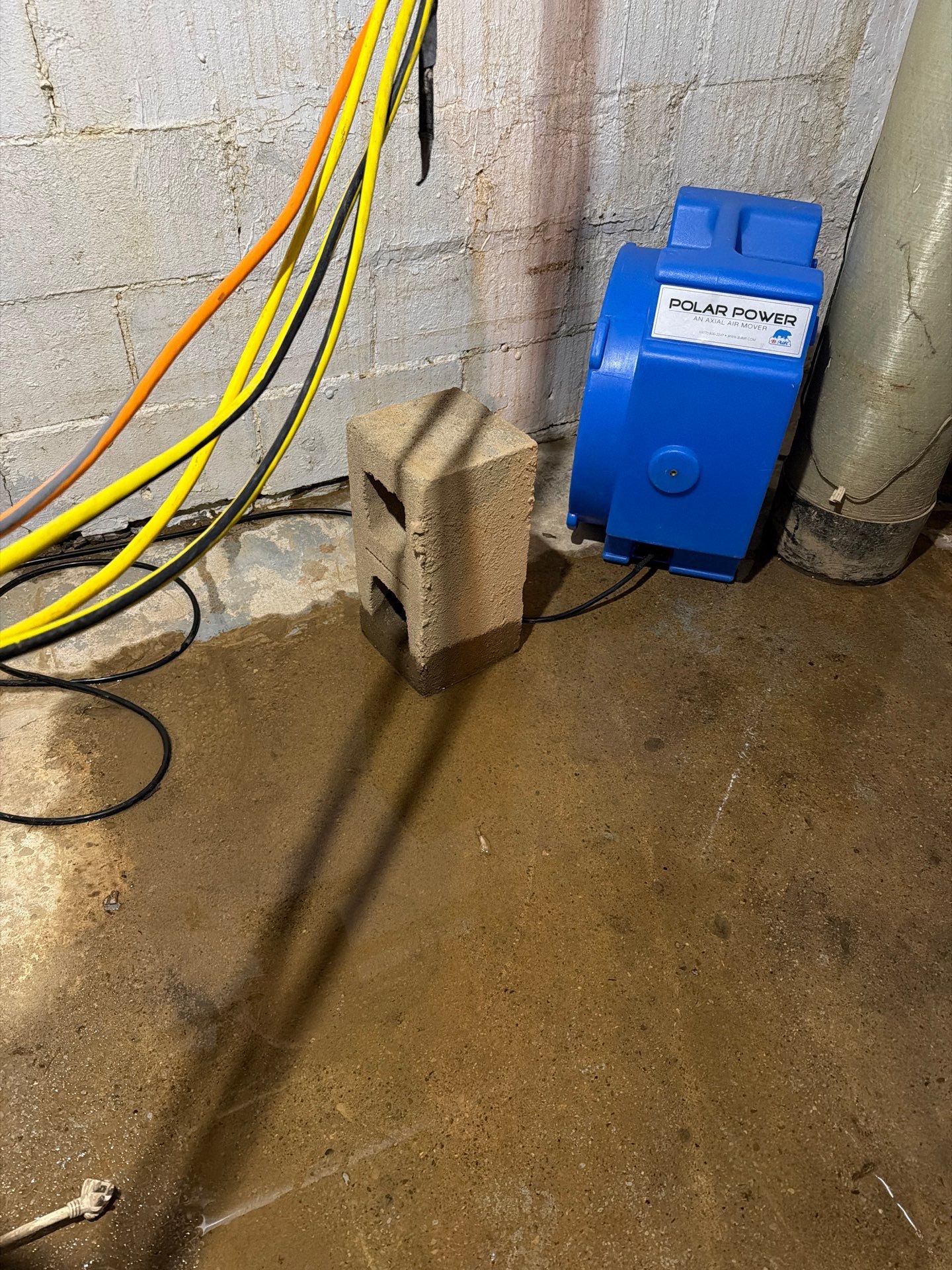
Step 1: Identify the Water Category Before Touching the Floor
- Category 1 (clean): Supply line, refrigerator line, sink overflow. Hardwood is often salvageable if extraction begins within 24 hours.
- Category 2 (gray): Dishwasher discharge, washing machine drain, aquarium. Salvage possible but requires antimicrobial application and faster drying.
- Category 3 (black): Sewage, toilet overflow past the trap, ground floodwater. Hardwood over Cat 3 is almost always a replacement, per IICRC S500 Section 12.2.
- Category escalation: Any Cat 1 source left untreated past 48 hours in Viking Meadows humidity reclassifies to Cat 2. Past 72 hours, treat as Cat 3 regardless of origin.
Document the source with photos before any cleanup. For sewage events, review our Category 3 water removal protocol before stepping on the floor.
Step 2: Extract Standing Water Within 60 Minutes
- Use a wet/dry vacuum or weighted extraction tool. Target removal rate: 95% of surface water within the first hour.
- Do not mop. Mopping pushes water deeper into board seams and increases absorption by 15 to 20%.
- Pull area rugs, furniture pads, and any cellulose item touching the floor. These wick moisture and slow drying.
- Lift one register cover and check for water in the duct. HVAC contamination changes the scope entirely.
- Tape a plastic sheet over any open seam wider than 1/8 inch before extraction. This prevents the vacuum from pulling subfloor fines into the canister and clogging the filter mid-job.
- Note baseboards. If water wicked above 2 inches on the baseboard, plan for removal during the drying phase to access the wall cavity.
Step 9: Schedule Refinishing or Replacement
- If saved: Wait 30 to 60 days post-dry for full equilibration before sanding. Premature refinishing causes crowning.
- If partial replacement: Match species, cut, and finish. Plan for blend sanding across 3 to 5 board widths.
- If full replacement: Remove planks, inspect subfloor for delamination, replace any plywood reading above 16% after 14 days. Coordinate with the water damage restoration scope so insurance pays both materials and labor as one claim.
Step 5: Decide Save vs. Replace Using a Three-Factor Test
- Factor A, moisture differential: If subfloor reads more than 4 percentage points above plank surface after 72 hours of drying, mat-drying or removal is required.
- Factor B, deformation severity: Cupping under 1/16 inch across a 5-inch plank usually flattens. Over 1/8 inch rarely recovers fully.
- Factor C, time elapsed: Under 48 hours from event = high salvage probability. Over 7 days with no drying = replacement is typically the honest answer.
If two of three factors fail, replacement is the better path. Viking Meadows Water Restoration documents all three on the loss report so your adjuster has defensible data. Engineered products with veneer under 2mm fail Factor B faster than solid 3/4 inch oak, so adjust expectations by product type.
Step 11: Insurance Documentation Checklist
- Source photos taken before extraction, with a timestamp visible.
- Moisture map showing all reading points and daily values.
- Equipment log: serial numbers, run hours, placement diagram.
- Category determination signed by the technician with reference to IICRC S500.
- Pre-loss flooring documentation: receipts, prior photos, or MLS listing images showing the floor before the event.
Step 6: Deploy the Drying System
- Air movers: One unit per 50 to 60 linear feet of wall, angled at 10 to 25 degrees across the floor surface.
- Dehumidifier sizing: LGR (low grain refrigerant) unit, 1 pint per square foot per day capacity minimum. For a 400 sq ft room, that is a 70 to 130 pint LGR.
- Mat drying system: For trapped subfloor moisture, deploy a tented mat system pulling negative pressure through plank seams. Required when subfloor exceeds 18% with surface reading under 14%.
- Target conditions: 80 to 90 degrees F, relative humidity 30 to 40%, specific humidity below 70 gpp.
- Duration: 5 to 10 days for top-down drying. 7 to 14 days for mat-assisted drying.
- Containment: Seal doorways with 6 mil poly when drying a single room. Unconfined drying loses 20 to 35% of dehumidifier capacity to adjacent spaces.
For broader context on extraction equipment selection, see our standing water removal guide.
Step 8: Verify Dry Standard Before Demobilization
- Wood moisture matches a clean reference area within 2 percentage points.
- Subfloor within 2 points of pre-loss equilibrium (typically 8 to 12% in Viking Meadows).
- No visible cupping greater than 1/32 inch.
- Ambient RH stable under 50% for 24 consecutive hours.
- Confirm no hidden moisture under thresholds, transitions, or kitchen toe-kicks using a pin meter at each penetration.
Step 3: Take Moisture Readings at Four Points
- Wood surface: Pinless meter, scale set to oak or species equivalent. Normal: 6 to 9%. Action threshold: above 12%.
- Subfloor: Pin meter through a seam or expansion gap. Plywood normal: 8 to 12%. Action threshold: above 16%.
- Adjacent drywall (bottom 16 inches): Pinless, on scale 1. Normal under 0.5. Action above 0.7.
- Ambient air: Thermo-hygrometer. Target 60 to 80 grains per pound for drying; above 100 gpp slows evaporation significantly.
- Reference reading: Take one set of readings in an unaffected room of the same home. This becomes the dry standard target, not a generic chart value.
Mark each reading location with painter's tape and a number. You will retake these every 24 hours. Photograph the meter display next to the tape number so the file timestamp links each value to a specific location.
Step 4: Classify the Damage Pattern
- Cupping (edges raised, center lower): Bottom of plank is wetter than top. Most common pattern. Salvage rate 70 to 85% with controlled drying.
- Crowning (center raised, edges lower): Top was sanded while bottom was still wet, or surface dried faster than substrate. Often follows premature refinishing.
- Buckling (planks lifted off subfloor): Fastener failure. Salvage rate under 20%. Usually replacement.
- Staining and tannin bleed: Cosmetic. Sand and refinish after structural drying completes.
- Delamination (engineered only): Top veneer separating from core. Not repairable. Replace affected boards.
- Sidebonding fracture: Adjacent planks glued at the edges (common in factory-finished products) split apart as the boards swell. Look for hairline cracks along the bevel. These boards rarely tighten back during drying.
Step 10: Cost Reference for Viking Meadows Homeowners
- Emergency extraction and initial setup: $500 to $1,500.
- Drying equipment, 5 to 10 days: $1,200 to $3,500.
- Mat-drying system add-on: $800 to $2,000.
- Refinishing salvaged floors: $4 to $8 per sq ft.
- Full replacement, hardwood: $10 to $18 per sq ft installed.
- Subfloor replacement (if required): $2.50 to $4.50 per sq ft for 3/4 inch plywood, including fastening and leveling.
Step 7: Daily Documentation and Recheck
- Log moisture readings at all four points every 24 hours.
- Photograph each reading with the meter visible.
- Record dehumidifier grain depression (intake gpp minus exhaust gpp). Target 30 gpp depression minimum.
- Adjust equipment placement if any plank fails to lose at least 1 percentage point of moisture per 48 hours.
- Verify air mover amp draw at the panel. Tripped breakers during overnight hours are the most common cause of stalled drying progress.